A new word or phrase from the Hans Wehr dictionary, every Wednesday.

Learning Arabic, one page at a time
A new word or phrase from the Hans Wehr dictionary, every Wednesday.
غُطَيْطة
root: غ-ط-ط / diminutive noun / definition: fog
I overslept this morning.
Upon rising: a foggy, rainy sky, and a suspiciously clear mind.
Is there a term for the inverse of pathetic fallacy? What do we call it when my brain fog has ventured into the sky and its cloudlessness has migrated into my head?
Continue reading “Dictionary Finds: غُطَيطة”A new word or phrase from the Hans Wehr dictionary, every Wednesday.

زَوْجة
root: ز-و-ج / noun / definition: wife
One way to understand how a particular culturo-linguistic group view a concept is by looking into their dictionary.
So, what does the Arabic dictionary tell us about how a wife is perceived?
Setting aside the common term زَوجة (literally meaning “one of a pair”), let’s explore some uncommon words that also mean “wife”:
Continue reading “Uncommon Arabic Words for Wife”A new word or phrase from the Hans Wehr dictionary, every Wednesday.

نور
root: ن-و-ر / noun / plural: أَنْوار / definition: light
Perhaps I was too busy playing in the tides of the summer heatwaves to realise that the season was ebbing into the horizon—and then, at six this morning, I woke up to a Sun-less sky and realised the days do feel shorter again.
I got up and made lentil soup and stared at the colour of autumn in the bowl. Somehow, it’s September.
And as the window of light begins to close, I can only think about نور.
Continue reading “Root Exploration: ن-و-ر”A new word or phrase from the Hans Wehr dictionary, every Wednesday.
جَسَد
root: ج-س-د / noun / plural: أَجْساد / definition: body
We’ve looked at word twins before—that is, two words with the same meaning that differ only in a single letter, like ضَجّة and لَجّة, or بُقْعة and رُقْعة, or سَهِرَ and سَهِدَ.
But there’s more to the story; synonyms carry similar sounds in different ways. For example, there are groups of Arabic synonyms that start with the same letter.
So it seems it’s not just about twins, there are whole family trees to explore…
Continue reading “Arabic Observations: ج and the Body”A new word or phrase from the Hans Wehr dictionary, every Wednesday.


جَريمة
root: ج-ر-م / noun / plural: جَرائِم / definition: crime
What do youngest siblings have in common with lawlessness?
A few ideas might spring to your mind (although I, as the youngest child myself, see no relation whatsoever…).
But Arabic dictionaries hold the two definitions under the same term. Let’s see why.
Continue reading “Dictionary Finds: Lawlessness and the Last Child”A new word or phrase from the Hans Wehr dictionary, every Wednesday.

تَطْبيق
root: ط-ب-ق / form II verbal noun / plural: تَطْبيقات / definition: app, application
I n three Tuesdays it’ll be autumn—but no one has time to dwell on that because, here in London, we’re being pulled into the swell of a fifth heatwave and our fridge is still full of pink-red watermelon.
So, we’re still firmly in الصَّيْف (summer). And that reminds me of last month’s dictionary find. And it also reminds me that it’s been around one-and-a-half years since I began working with a fellow Arabic enthusiast and app developer on a new project.
Arabic lovers, language learners, curious linguists: ArabyBuddy is here.
Continue reading “A New App: ArabyBuddy”A new word or phrase from the Hans Wehr dictionary, every Wednesday.


أَجْوَف
root: ج-و-ف / adjective / definition: hollow
Two weeks ago, in one of our Academic Arabic posts, we looked at the form I, hollow verb قامَ which—when followed by بِـ—means “to carry out or undertake”.
But قام holds many meanings. And its meaning in any given place is dictated by the semantic and syntactic context. (Keeping an eye out for the following preposition is key!)
Shall we explore?
Continue reading “Arabic’s Chameleon Words: قام”A new word or phrase from the Hans Wehr dictionary, every Wednesday.

فَلَك
root: ف-ل-ك / noun / plural: أَفْلاك / definition: celestial orbit
July is waning and August, only four moonrises away, awaits expectantly.
And I, in four new moons, reach 29 (or 30, Turkish-ly speaking) and all this talk of moons is sending me into an orbital spin. Whatever that may mean.
And speaking of counting and meaning, did you know that there’s a one-letter Arabic particle that carries a whole system of definitions and connotations?
Continue reading “The Many Meanings of وَ”A new word or phrase from the Hans Wehr dictionary, every Wednesday.
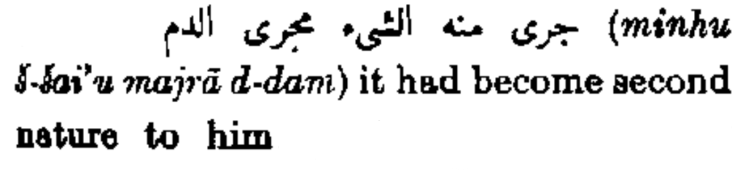
root: ك-و-د / form I past tense verb / definition: almost
When was the last time I wrote an Academic Arabic post? Too long ago, clearly, because I almost forgot this series existed.
But since my memory has been jogged, we’re getting back into it.
And today, we’re looking at two widely-applicable Arabic verbs that you’ll read or hear in academic contexts. They’re pretty much academic ways of saying doing.
Continue reading “Academic Arabic: Carrying Out, Conducting, Doing”A new word or phrase from the Hans Wehr dictionary, every Wednesday.


يَصيفُ
root: ص-ي-ف / form I present tense, hollow verb / definition: to be summery
It’s mid-July. Summer’s peak. And while most have their faces stubbornly positioned in a fan’s airpath, my own spectacled one has been nestled warmly into the dictionary’s pages.
It seems that, come rain or shine, my mind will always be drawn back to one place. And—oh!—there’s an Arabic phrase for that.
Come rain or shine, meet صاف الزمان أم شتا.
Continue reading “Dictionary Finds: Come Rain or Shine” The Arabic Pages