
دَجاج
root: د-ج-ج / collective noun / definition: chicken
Have you ever roasted a chicken upside down? Well I have. Twice. Well, it was one time—but two chickens.
No questions, please. This was a cathartic confession, blurted out in a fluster of shame, and no more than that.
Thank God for the antidote of blushing: distraction. And that’s why I’m launching into another post about Arabic-Akkadian roots. This time, we’re looking at these three Semitic roots which are present in both languages: ʿ-l-w, ʾ-k-l, and b-k-y.
Let’s begin:
ʿ-l-w
The defective root ع-ل-و in Arabic carries meanings related to elevation and ascension.
For example, the form I عَلا / يَعلو means to be high, to ascend, and to overcome. The form II and form IV verbs, عَلّى / يُعَلّي and أَعلى / يُعلي respectively, mean to raise and elevate. And the root also gives rise to form V, VI, VIII, and X verbs with similar denotations.
Basically, the root is about all things high or rising.
As for the Akkadian, this root is listed in the dictionary as ‘-l-‘. The first ‘ corresponding to the Arabic ع and the second referring to the weak letter و.

(We see this ‘/w interchange in Akkadian words like alād-um/walād-um too, which incidentally corresponds to the Arabic root و-ل-د, related to birth!)
Anyway, back to ‘-l-‘:
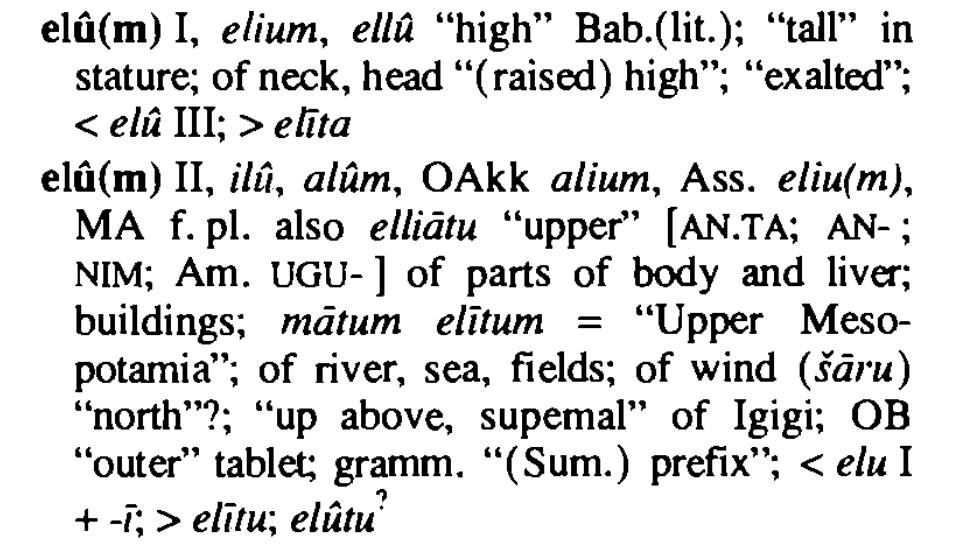
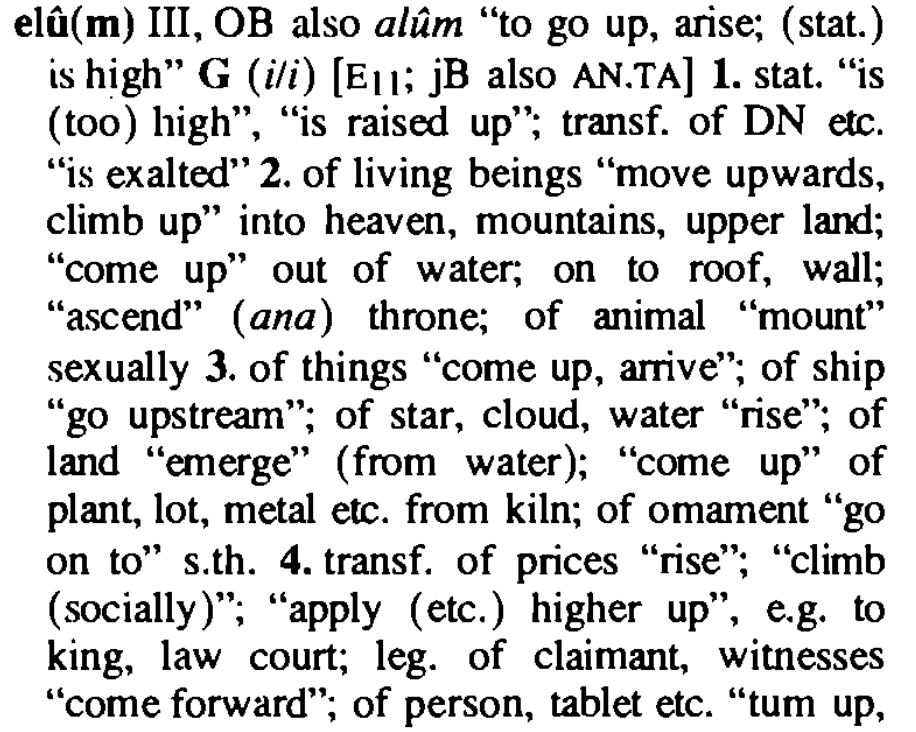
The verb forms and nouns from the Akkadian root are also about elevation and ascension. The G-stem verb (above) corresponds to the Arabic form I verb (i.e. stative or intransitive) while the D-stem (below) corresponds to the Arabic form II (i.e. transitive and causative).
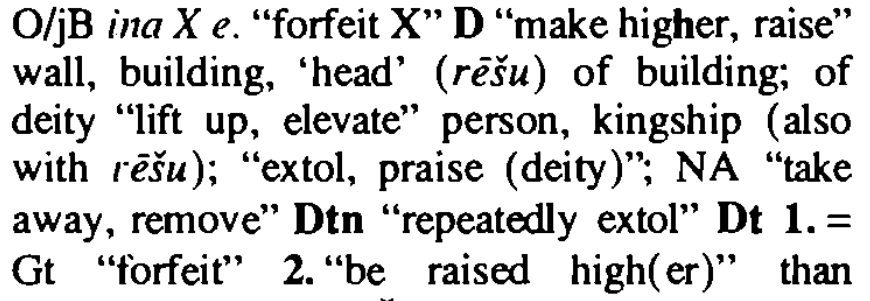
…but more on Arabic-Akkadian verb forms in another post.
ʾ-k-l
In Arabic, the core meaning of the hamzated root ء-ك-ل is eating.
Find out more about how the hamza takes different forms depending on its position in Seats of the Hamza (ء)
The form I verb أَكَلَ / يَأكُلُ means to eat, and the causative form II and form IV verbs—أَكَّلَ / يُؤَكِّلُ and آكَلَ / يُؤْكِلُ, respectively—mean to feed.
See What’s the Difference between Form II and Form IV Verbs?
Then we have the form III آكَلَ / يُؤاكِلُ (to dine with someone), and the form V and VI verbs, تَأَكَّلَ / يَتَأَكَّلُ and تَآكَلَ / يَتَآكَلُ (to be eaten away).
Of course, the noun أَكَل also means food, and أُكُل is another word for fruit.
Onto the Akkadian root ‘-k-l, starting with the verbs:
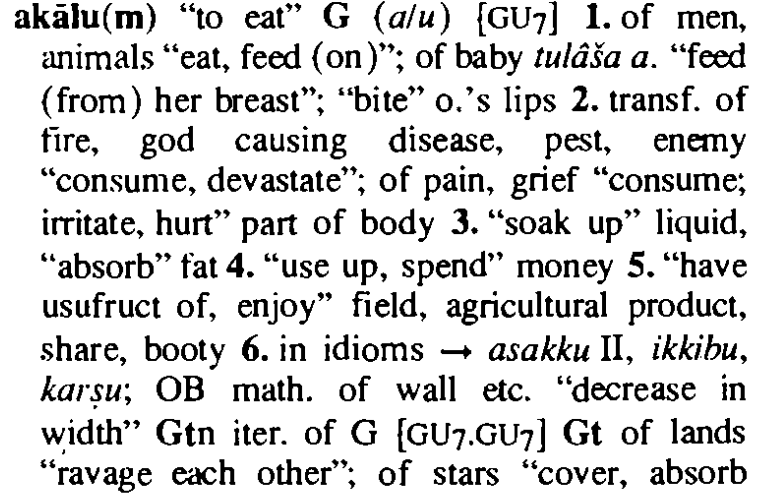
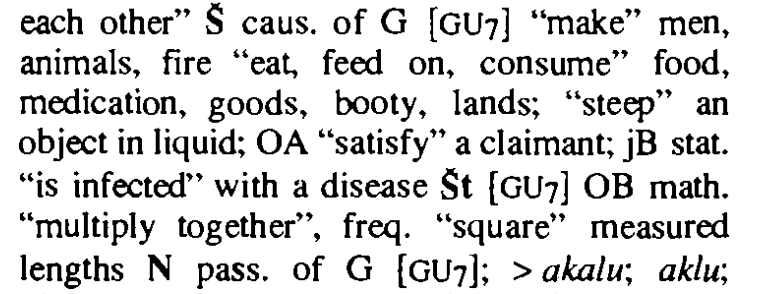
Again, the root is associated primarily with eating, also carrying similarly metaphorical meanings like to consume/destroy something and to spend money. (Although, in Arabic, أَكَلَ specifically refers to spending money unlawfully.)
As for the nouns, we find this in the Akkadian dictionary:
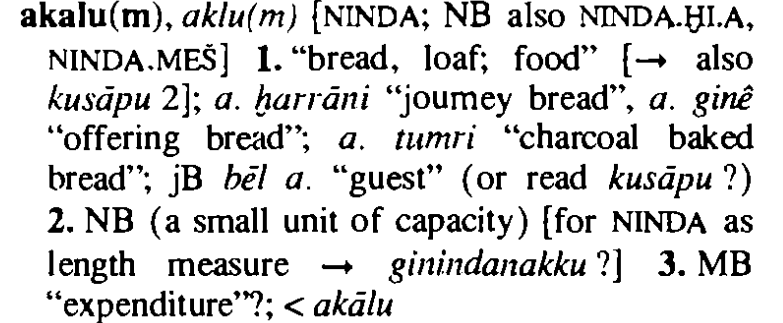
In Akkadian, akal-um means bread, as well as food.
I assume this is because bread was a staple food. But could it also be related to those verb definitions nestled among the others: to soak up liquid and to steep something in liquid? I mean, that’s how they probably ate bread, right?
(Historians: weigh in please!)
b-k-y
The Arabic defective root ب-ك-ي is all about crying. (And weeping and lamenting, etc.)
The form I بَكى / يَبكي means to cry. The causative form II and IV verbs, بَكّى / يُبَكّي and أَبكى / يُبكي, mean to make someone cry. And the form X اِستَبكى / يَستَبكي means to move someone to tears.
And the Akkadian root b-k-‘ holds the same core meaning:
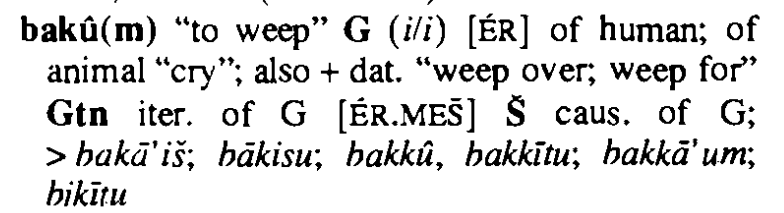
It comes along with derived nouns and an adjective too:
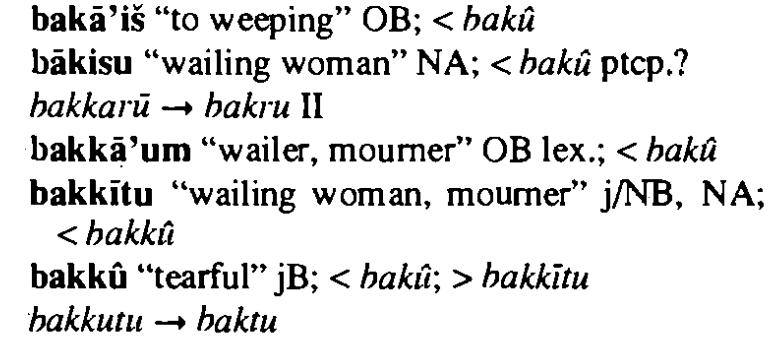
You might notice that some of these Akkadian nouns and their forms correspond with the Arabic ones from the same root. For instance, the counterpart of the Akkadian bakkā’um (mourner, wailer) is the Arabic بَكّاءٌ (someone who weeps a lot).
You might be wondering: where are these posts going? What point are you trying to make?
The thing is, I’m not trying to make any point at all. There’s no destination.
I’m just taking you with me as I wander through these sister languages and appreciate how connected we still are to a culture and language that were alive thousands of years before us.
Fancy more posts about Akkadian? Check these out:
- Some Arabic-Akkadian Lexical Observations
- Arabic-Akkadian Observations: talmīd, تِلميذ, and a Lost Root
- Arabic Epiphanies in Akkadian Class: خلق, the Rule of 12, and 19 Verb Forms
- Arabic-Akkadian Roots: q-b-l, k-l-m, and m-l-k
!إلى اللقاء


If you’d like to receive email notifications whenever a new post is published on The Arabic Pages, enter your email below and click “Subscribe”:


One thought on “Arabic-Akkadian Roots: ء-ك-ل ,ع-ل-و, and ب-ك-ي”