A new word or phrase from the Hans Wehr dictionary, every Wednesday.

Learning Arabic, one page at a time
A new word or phrase from the Hans Wehr dictionary, every Wednesday.
دار
root: د-و-ر / noun / plural: دِيار / definition: home
I had this idea a few days ago to vlog a week in my life as a PhD student. And now, every action poses a conundrum.
Like, do I record the aftermath of my disastrous attempt to bake a sugar-free brownie without a recipe or so much as a clue? Would my hypothetical audience find it interesting to watch me pour a rose-flavoured honey concoction over the resulting charcoal block to bring it to the edge of edibility?
And forget edibility— should I be worried about the credibility I’ll lose posting chaotic snippets of my days which, thus far, have scarcely featured “actual work”?
Continue reading “Dictionary Finds: بقيت دار لقمان على حالها”A new word or phrase from the Hans Wehr dictionary, every Wednesday.
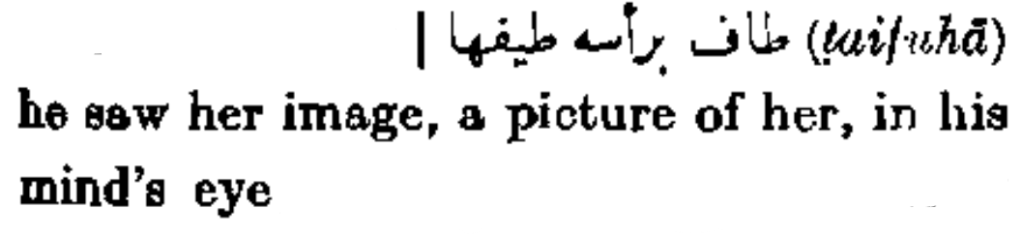

أَخير
root: ء-خ-ر / adjective / definition: last
Something usually goes wrong in the first few days of me living alone.
This time? I almost got locked out of the house, thanks to a jammed lock (remedied with olive oil, what else?)—oh, and I almost poisoned myself.
After messaging my sister to make sure she had a spare key (in case she needed to come to my rescue), I picked myself up off the floor and brewed a ginger tea (her advice) to allay the nausea. It worked in a sip. Who knew.
Continue reading “A De-Forgotten Song, an Antidote, a Last Post”A new word or phrase from the Hans Wehr dictionary, every Wednesday.


اِنْتِظار
root: ن-ظ-ر / form VIII verbal noun / definition: waiting
Time and tide wait for no man.
Yesterday was the first day I came across this English proverb. Its meaning resonated, but what really drew me to this phrase was the word “tide”.
You see, I’ve been thinking about the sea a lot lately. Thinking a lot, but writing little. (The eternal state of the PhD student…) And all my thoughts are cut-off sentences that hiccup before they reach a full stop or enigmatically trail off.
Continue reading “Arabic Diptotes: الممنوع من الصرف”A new word or phrase from the Hans Wehr dictionary, every Wednesday.

البَشَر
root: ب-ش-ر / noun / definition: mankind
For someone who aspires for a slow-paced life, I sure do seem to be on the go a lot.
“Another project?” they ask. Yes, apparently so. I’ve been liaising with venues and thinking of my friend’s article in between organising a family trip on an I’ll-reply-when-I-can group chat and agreeing to increase the capacity of a barely-prepared workshop I’m convening in four weeks due to apparent demand.
I’m thinking to gatecrash my parents’ retirement plans at this point.
But I think this, here and now, is me spiralling up a storm with firm belief that calm will inevitably follow.
Continue reading “Uncommon Arabic Words for Mankind”A new word or phrase from the Hans Wehr dictionary, every Wednesday.


لِسان
root: ل-س-ن / noun / plural: أَلسِنة، أَلسُن / definition: tongue, language
I’m on day 3 of a five-day run of meetings and meet-ups. TfL continues to fleece me, my average step count continues to rise, and I continue to wonder what kind of rehab my introverted self will need after this.
Popping into the Hackney Cypriot Association today, I was too shy of my broken mother tongue to open my mouth.
I mumbled a few “iyi“s and “güzel“s and made off with two boxes of freshly-made bulgur köftes that were as familiar to my tongue as the dialects chattering around me. There’s something about that connection, isn’t there?
Continue reading “The Taste of Language”A new word or phrase from the Hans Wehr dictionary, every Wednesday.

صَباح
root: ص-ب-ح / noun / definition: morning
Today, I woke up busy. I spent all my morning hours—and half of my afternoon ones—on my rocking chair with laptop in lap, steadily ticking through my checklist.
I’ll become a morning person by force at this rate.
Yet, don’t fret, nothing can distract me from writing on this blog. And I think another post in the Academic Arabic series is long overdue.
Continue reading “Academic Arabic: Bridging, Framing, and Projecting”A new word or phrase from the Hans Wehr dictionary, every Wednesday.


صُداع
root: ص-د-ع / noun / definition: headache
I keep forgetting I’m 27. In my head, I’m already 28, and I’m not sure why.
It’s slightly ironic that I can’t digest the number 27; it seems I recognise 27 in everything but myself.
(I wonder if I lost a year in the time difference between Doha and London.)
Continue reading “إيمان: Form IV Verbal Nouns of Hamza-Initial Roots”A new word or phrase from the Hans Wehr dictionary, every Wednesday.


كاتِبة
root: ك-ت-ب / form I active participle, feminine form / definition: writing, a writer
I get emotionally attached to plans. I’ve been gathering quotes, ideas, and notes for months—only to realise there’s not enough word count (or time) to include everything in the chapter I’m writing.
So I save bullet points of brain clutter in a separate document and delude myself that I’ll one day go back and make use of them. It’s an empty hope I feed myself to allay my grief over orphaned ideas that find no page to call home.
Continue reading “Writer’s Grief and Closing a Chapter”A new word or phrase from the Hans Wehr dictionary, every Wednesday.

سائِع
root: س-و-ع / form I active participle / definition: abandoned
Do you remember, back in January, when we explored why سنة is longer than عام?
Well, we’re back with the Exploring Time series—and this time we’re taking a deep dive into the Arabic word for “hour”. And it’s more interesting than you might expect…
Continue reading “Exploring Time in the Arabic Dictionary: “Hour””A new word or phrase from the Hans Wehr dictionary, every Wednesday.


مَخْفيّ
root: خ-ف-ي / adjective / definition: hidden, concealed
Last week, I attended an online talk about developing a writing system for Cypriot Arabic. As a Cypriot linguist who’s studying Arabic, I kind of couldn’t miss it.
I hadn’t realised, though, that it was a “camera-on” event—so I quickly threw on a headscarf and smoothed my eyebrows to look somewhat presentable before flicking open my webcam.
One of the things I learnt was that the letter ع is the only emphatic consonant from Standard Arabic to survive in Cypriot Arabic.
I wonder whether mourning phonemes is illogical. I mean, Arabic emphatics are pretty cool. And have you heard about how they can mask verb forms?
Continue reading “Hidden Form V Verbs in the Qur’an” The Arabic Pages