
حَجْز
root: ح-ج-ز / form I verbal noun / definition: booking, reserving
Independently organising a three-week trip for four people across multiple cities—with international and internal flights, cross-country trains, five hotels, and jam-packed itineraries (plus sudden cancellations and panicked rebookings)—made me want to curl up in a suitcase and cry.
Dry sobs on a warm shoulder sufficed, and I wrapped things up with a final booking and a prayer.
To sweep away residual stress, I open two dictionaries: an Arabic one, and an Akkadian one.
Today, we’re looking at two roots shared by these two Semitic languages. Let’s begin!
ʾ-x-đ
The core meaning of the hamzated root ء-خ-ذ in Arabic is taking.
Both the form I (أَخَذَ / يَأخُذُ) and form VIII (اِتَّخَذَ / يَتَّخِذُ) verbs mean to take. They also carry related meanings like to adopt, to take on, and a plethora of denotations when followed by a preposition.
In Akkadian, meanings of the equivalent root ‘-ḫ-z in the dictionary also centre around the idea of taking, giving rise to meanings such as to take, to marry (i.e. take someone in marriage), to learn (i.e. take knowledge), and so on:

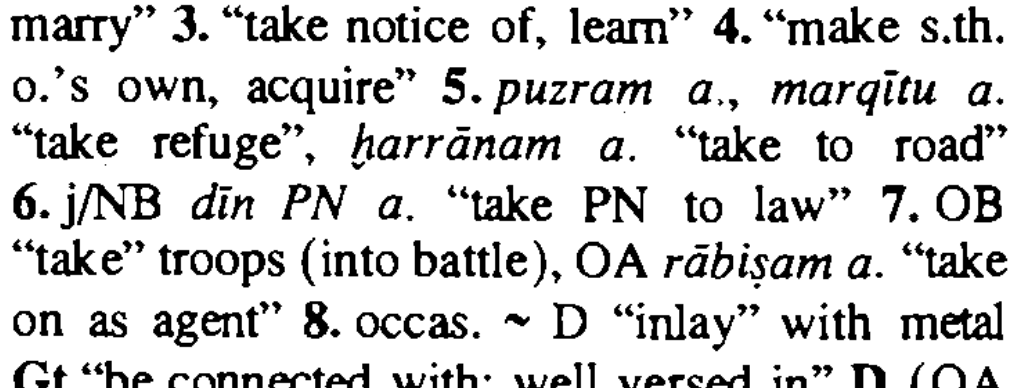
Like the Arabic root, the Akkadian ‘-ḫ-z branches into numerous denotations associated with the idea of taking across its different verb forms—including taking to the road and taking troops into battle.
I guess both the Arabic and Akkadian roots are chameleon.
w-l-d
The Arabic و-ل-د is an assimilated root related to birth.
For example, the form I (وَلَدَ / يَلِدُ) means to give birth or produce, the form II (وَلَّدَ / يُوَلِّدُ) means to generate or to raise a child, and so forth…
From among its nouns, we find: وَلَد (boy, child), أَولاد (children), وِلادة (childbirth), and—of course—والِدة (mother) and والِد (father).
Oh, and the words وَليد/مَولود (newborn) and ميلاد (birthday).
In the Akkadian dictionary, we find the root w-l-d. But we also find its derivatives on various pages due to the alphabetical ordering. We’ll explore why that is—but first, the root:
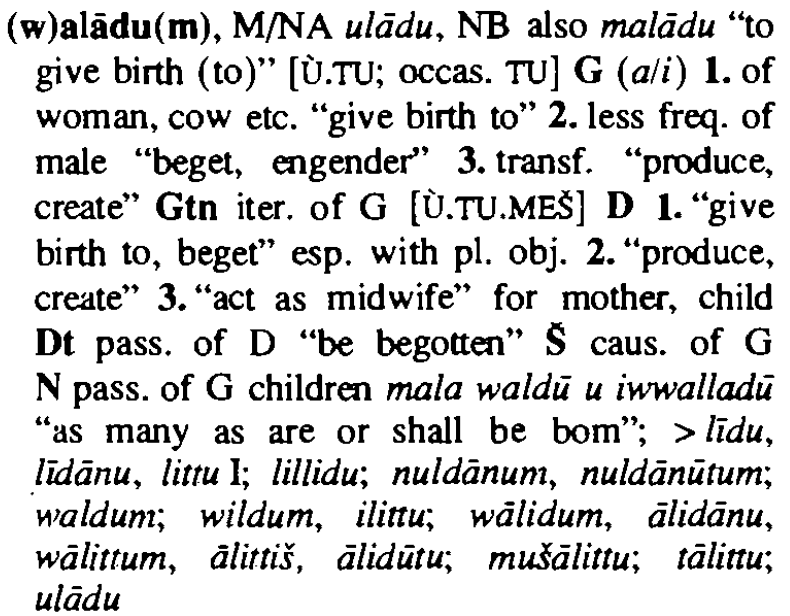
The Akkadian root carries the same core meaning as the Arabic: giving birth.
We also find meanings like to produce and to act as a midwife which appear in the Arabic dictionary too.
But seeing as this is an assimilated root (i.e. the first letter of the root is weak), the w doesn’t appear in some of its derivatives.
(Assimilated roots in Arabic drop their first letter in some forms and derivatives too. The form I present tense verb from و-ل-د, for example, is يَلِدُ.)
So we find that some nominal derivatives of the root omit the first root letter (w) and appear alphabetically in the dictionary under l or a vowel*:

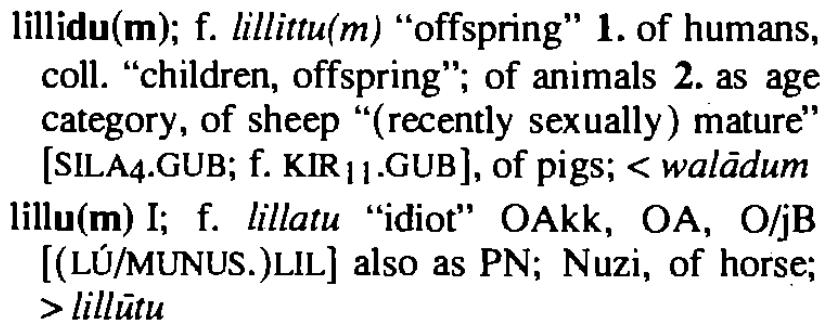

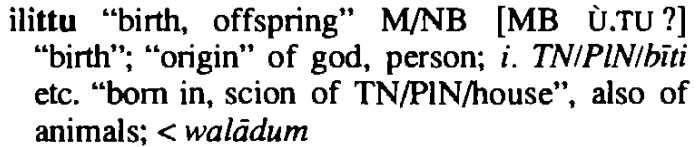
(*We saw how the w can be swapped with an alif/glottal stop/short vowel when we looked at the Arabic-Akkadian root ع-ل-و here too.)
The w is optional in the following nouns, which correspond to the Arabic والِد and والِدة:
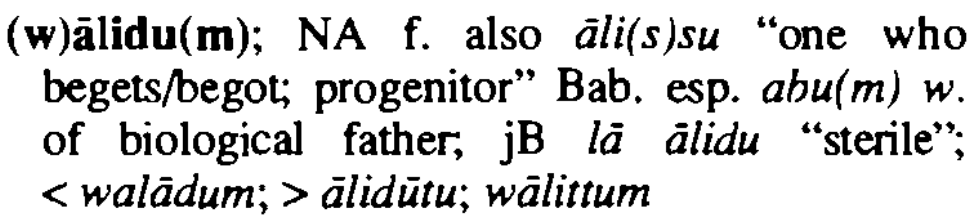
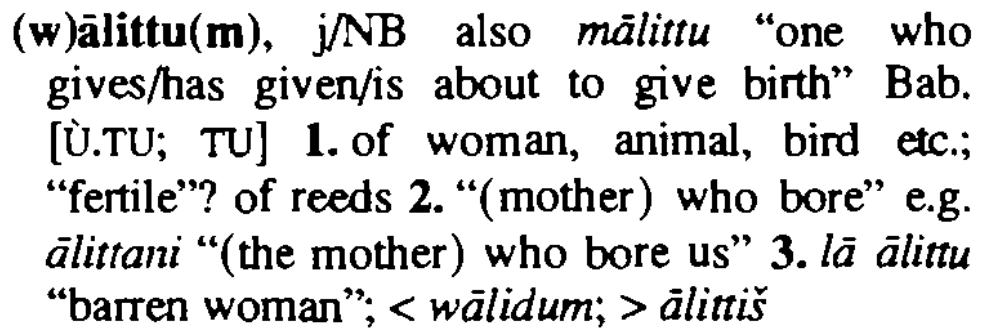
In the latter, notice how the final d assimilates to the following, feminine t sound. This takes the word from wālidt-um to wālitt-um. (This type of assimilation occurs in spoken Arabic too!)
And finally, another noun:

Mušāllittu is an active participle which corresponds to the form II active participle in Arabic, مُوَلِّدة (midwife).
Oh—but why has the w been replaced by a š (ش)?
This is actually from the verb form that it derives from, which is a Š-stem. And that reminds me that I still need to write a post comparing the Arabic and Akkadian verb forms.
(Maybe next month?)
Interested in more Arabic-Akkadian similarities? Check out these:
- Some Arabic-Akkadian Lexical Observations
- Arabic-Akkadian Observations: talmīd, تِلميذ, and a Lost Root
- Arabic Epiphanies in Akkadian Class: خلق, the Rule of 12, and 19 Verb Forms
- Arabic-Akkadian Roots: q-b-l, k-l-m, and m-l-k
- Arabic-Akkadian Roots: ء-ك-ل ,ع-ل-و, and ب-ك-ي
!مع السلامة


If you’d like to receive email notifications whenever a new post is published on The Arabic Pages, enter your email below and click “Subscribe”:

