
سائِع
root: س-و-ع / form I active participle / definition: abandoned
Do you remember, back in January, when we explored why سنة is longer than عام?
Well, we’re back with the Exploring Time series—and this time we’re taking a deep dive into the Arabic word for “hour”. And it’s more interesting than you might expect…
ساعة
root: س-و-ع
So here we have it: ساعة.
It’s a feminine noun derived from the hollow root س-و-ع. It can form both a sound feminine plural (ساعات) and a broken plural (ساع), but the latter is relatively uncommon.
It’s defined in the dictionary as:
- an hour
- time
- a clock
When definite (الساعة) it’s used to refer to the Final Hour, i.e. the Hour of Resurrection.
The Hans Wehr doesn’t give us too much more than that, other than:
- a regular adverb (الساعةَ, “now”)
- the noun with the adverbial ـئذٍ suffix (ساعَتَئِذٍ, “in that hour”)
- the diminutive form (سُوَيْعة, “a little while”)
- and some collocations.
Not much else to explore, right? Wrong.
If we head to Lane’s Lexicon—my go-to Arabic-to-English dictionary when I want more etymological details—we find a whole lot more.
Let’s go to the form I verb under the root س-و-ع to begin with:
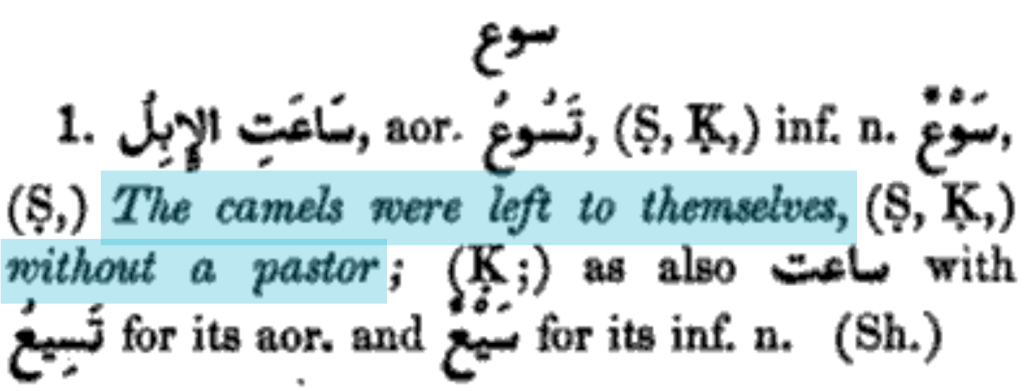
…where we see that ساعَ / يَسوع means “for camels to be left to themselves”.
(Note this differs from يَسوع as a noun—which is the name Arabic-speaking Christians use for Jesus!)
And the form IV verb carries a similar meaning, but in the active:

…meaning “to leave someone/something alone/neglected/lost/destroyed”. We also see a meaning more along the lines we’d expect (i.e. related to time) under the form IV—“to delay for an hour/for a while”:
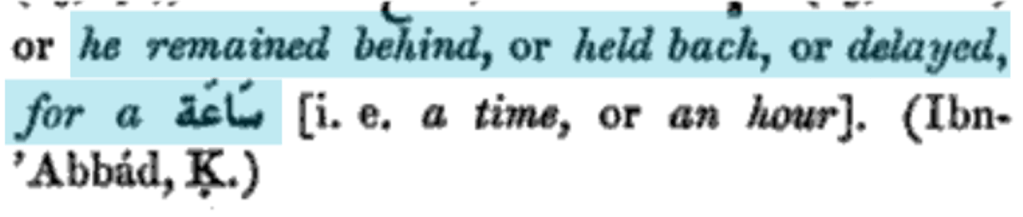
So we can see that the root س-و-ع is generally associated with abandonment—the type that, with the passing of hours, can lead to demise.
But there’s more.
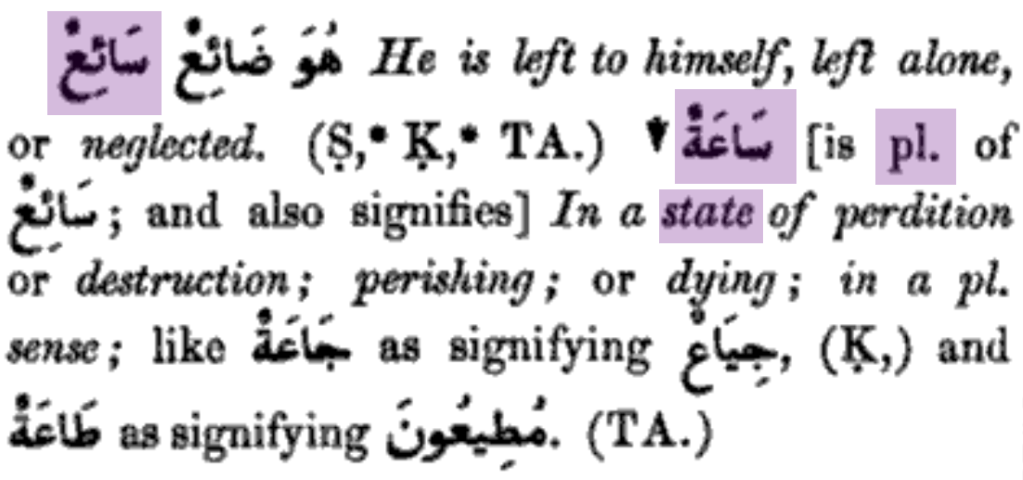
When we take a look at the form I active participle, سائع, we find something quite interesting:
(Curious about how سائع derives from the root? See Form I Active Participles of Hollow Roots!)
So, سائع means “neglected”, as we’d guessed based on the form I verb.
But the important thing here is that ساعة is both:
- the plural of سائع
- the related abstract noun, meaning “the state of destruction”
ساعة, then, links the notions of time and loss.
That’s deep isn’t it? But maybe things are even more profound…
Are we, in the deserts of time, like abandoned camels wandering towards an inevitable demise?
Will we then, with the arrival of that Final Hour, be left to fend for ourselves, at a loss as to where all the time went?
Ah, the Arabic dictionary always sends you into an existential crisis. As long as you read it right, of course.
There’s another word for “hour” in the dictionary too, you know. Why don’t you check out مَطْوة and see what insights you can get from it? I’d love to hear them.
Don’t forget to read last week’s post, Hidden Form V Verbs in the Qur’an, and I’ll see you on my next post!
.في أمان الله


If you’d like to receive email notifications whenever a new post is published on The Arabic Pages, enter your email below and click “Subscribe”:
 The Arabic Pages