
فاعِل
root: ف-ع-ل / noun / definition: subject (e.g. of a verb)
It’s no coincidence that I included “مِن قِبَلِ” in the very first Small but Useful Arabic Phrases That You Need To Know post. And because this phrase is so helpful, I thought it was worth making a post explaining how and when to use it.
Okay, so our first stop is the Hans Wehr dictionary (you can check out my simple guide to using this dictionary if you’re not familiar with it yet)…
Under the root ق-ب-ل, you’ll find the word “قِبَل”. And within its definitions, you’ll find this:
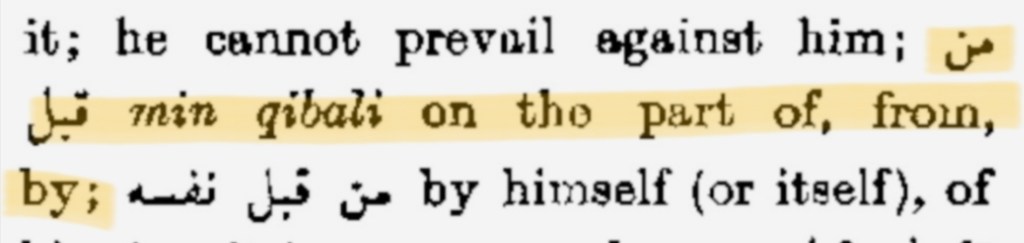
So the phrase is evidently made up of two components:
- مِن—a preposition, making the following word مجرور (i.e. having a kasra at the end)
- قِبَلِ—a noun meaning “power”/”ability”; this word forms an إضافة (possessive construction) with the word following it
When used together—as you can see from the image above—مِن قِبَلِ means: on the part of, from, or by.
In other words, it’s used to indicate the subject of a clause/sentence.
Note: don’t confuse مِن قِبَلِ with مِن قَبْلُ, which means “previously”/”before”.
The question is: in what context would we actually use this phrase?
The answer: مِن قِبَلِ is most often used when the “doer” of the verb comes later in the sentence.
Let’s look at the following example:
تَمَّ القَبْضُ عَلَيْهِ مِن قِبَلِ الشُّرْطَةِ
he was arrested by the police
The sentence begins with a passive construction, meaning that the subject of the verb is omitted in the first half of the sentence.
So if the writer wanted to clarify who did the “arresting” later in the clause, they would add “من قِبَل” followed by the subject, as you can see above.
Simple concept right? And it’ll come in handy too.
That’s all for this post—but if you haven’t had a chance to read last week’s one yet, do take a look at Two Ways to Say “Not Yet” in Arabic.
!إلى اللقاء
Follow The Arabic Pages on Instagram and Twitter, and find out how you can support this blog!
If you’d like to receive email notifications whenever a new post is published on The Arabic Pages, enter your email below and click “Subscribe”:
 The Arabic Pages
This practice is proscribed as it leads to weak sentences. It came about because of bad translations during the 19th-20th century, as with most things in MSA.
“As with most things in MSA”? To say that the language is a result of bad translations is not only bizarre, but completely untrue!
تم القبض عليه من قبل الشرطة
قبضت عليه الشرطة
How is the former any better or more grammatically correct than the latter? And side note, the construction “تم + مصدر” is an extremely weak and proscribed construction that came about as a result of the 19th century translation movement and was unheard of before then.
You’re right, it’s not “better” or “more correct” – but it does occur in MSA, so it’s important for students to know!
Side note: this is a blog about MSA 😅