إحْياء
root: ح-ي-و / form IV verbal noun / definition: revival
Every so often and very suddenly, a linguist (and I’m specifically talking about myself) gets ludicrously preoccupied with researching an extinct language or dialect and dreamily sketches out a grandiose plan to revive it… which, of course, firstly includes learning it.
It’s partly delusion—but honestly, some of my delusions do come into fruition, so I err on the side of optimism and add another linguistic revival to my to-do list (after Göktürk and Akkadian). Because why shouldn’t I.
*Cue my procrastinated PhD work breaking the surface for breath from the depths of forced oblivion, gasping desperately for any attention whatsoever.*
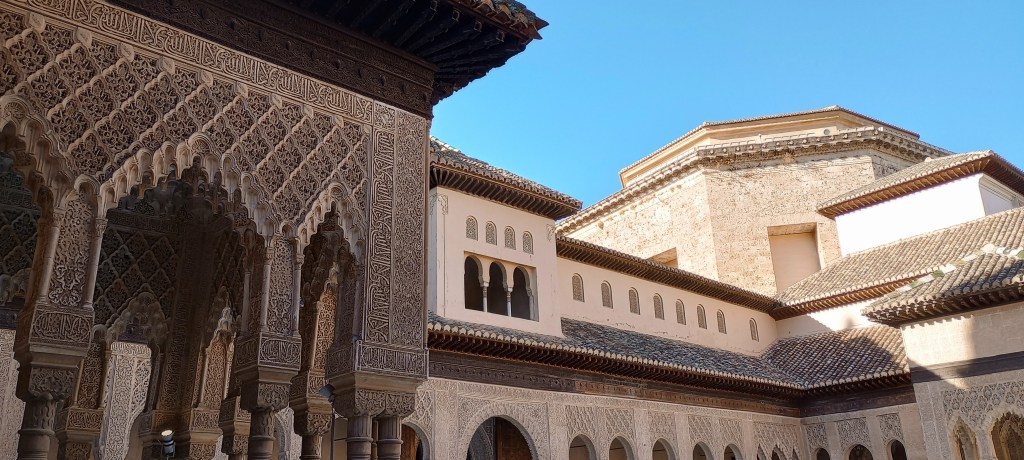
This week, as part of what I can only assume is my determined campaign of procrastination amidst deadline stress, I started looking more into Andalusi Arabic, a dialect of Arabic that was spoken in Spain’s Andalusia region quite some centuries ago.
It has some pretty interesting features. Here’s some of them:
- Short vowels and stress: the difference between long and short vowels ceased to exist in Andalusi Arabic, so all phonemic (pronounced) vowel length was short. In writing, the long vowels were sometimes kept to indicate vowel stress—الاندلوس (“Andalusia”) was pronounced alandalús. And sometimes, instead of writing a long vowel to indicate stress, the consonant following the stressed vowel was written twice—ثققة (“trust”) was pronounced θíqa.
- Passive vowelling of verbs: other Arabic dialects have ways around using the passive verb form, which relies on changing the vowels of an active verb. But Andalusi maintained the classical way of doing things—tarjam (“he translated”) in its passive form was turjim (“it was translated”), just like Modern Standard Arabic.
- Gender shifts and distinction: interestingly, there was no gender distinction in the second person singular (أنت)—so, for example, whether addressing a male or female, you would have used the verb taḥtarám (“you respect”). Also, several Andalusi Arabic words switched genders to match their equivalents in the Romance language it was in contact with—šáms (“sun”) became masculine in many cases and má (“water”) was feminine.
- Additional phonemes: Andalusi had the additional sounds p and t͡ʃ (which is like ch in English). The letter ق is also thought to have been pronounced as g, by some speakers at least—it’s pronounced this way in some modern Arabic dialects too.
Examples are mostly from this chapter, and there are so many more cool phonological, morphological, and syntactic features than I’ve mentioned here. But I’m hoping to tempt you to read more about Andalusi Arabic yourself so I can ask: who wants to revive an extinct dialect with me?
(This is rhetorical. Please don’t encourage my procrastination.)
(It’s high time I give that PhD some much-needed attention.)
!مع السلامة


If you’d like to receive email notifications whenever a new post is published on The Arabic Pages, enter your email below and click “Subscribe”:
 The Arabic Pages
Intervowelled ‘ب’ also became ‘اُ/و’ phonetically fairly often, just as many intervocalic ‘b’ and ‘p’ in Latin phonetically became either ‘u’ or ‘v’ in Western Romance languages. This is attested in Iberian Romance Arabisms like “ataúd/ataúde”, from Andalusí Arabic «التَابُوْتْ» (perhaps even «التَابُوْثْ», given the last consonantal phoneme in Spanish, Portuguese, Aragonese, and Valèncian; as well as the fact that word-ending ‘d’ becomes plosive in Modern Andaluçian Romance and Andalucian Spanish); and “recua”, from Andalusí Arabic «رِكْبَة». t͡s was also part of the Andalusí phonetic pool, it was variously but non-exclusively the spelling for ‘س’ (as in «السُّوْرَة», ‘as-sūrah’ → ‘aç-çórah’ → “açora” → “azora”; literally “sūrah” in Spanish now) or ‘ص’ (as in «صَنِيْڢَة», ‘sanīfah’ → ‘çenéfah’ → “cenefa”, any garment’s decorative border), or one of the two transcriptions of a unique affricate feat in most Medieval Iberian Romances, and still extant in Andaluçian Romance and Andaluçian Spanish, where the graphemic cluster ‘st’/ست/سط/صت/صط’ is inverted its phonetic value (as in «الڢُسْتِقْ», ‘al-fustiq’ → ‘al-fóçiq’ → “alfóçigo” → “alfócigo”, Spanish for “pistachio”, though it’s fallen out of use in favour of “pistacho”; and one that’s got an instance of the former as well: «سَرَقُسْطَة», ‘Saraqustah’ → ‘Çaraqóçah’ → “Çaragoça” → “Zaragoza”, the city thus named), bearing in mind that t͡s used to be erstwhile transcribed as ‘ç’ in Old Castilian, it’s actually where the letter first sprang from. For more on this, you may check out a chapter named “Language” by Consuelo López Morillas, from “The Literature of al-Andalus” (Cambridge University Press, 2012), edited by María Rosa Menocal, Raymond P. Scheindlin, and Michael Sells.
Andalusí Arabic (which had a few registres and several subdialects of its own as well) wasn’t spoken just in modern day Andalucía though. It was spoken across most of the Peninsula from around mid 9th century and until around mid to late 14th century, coexisting in diglossia with Andalusí Romance (the so often wrongly named “Mozarabic”, and which Andalusís themselves seemed to have referred to simply as “Span” —as their Visigothic ancestors did to the Romance language they spoke— or “Spaní”, from the Visigoths’ rendering of Latin “Hispaniæ”: Spania) until around early 13th century across most socially Islamicate settings —including the Islamicate Sephardim (these had actual triglossia going on to some degree, as Hebrew has had a distinctly Romance-tinted variety spoken by the Sephardim from back then and ever since) and Islamicate Christians, the latter ones having even developed their own liturgical rite now known as “Mozarabic Rite”—; and finally fading away to Islamophobic genocide in early 17th century Kingdom of València. Those linguistic milieus across the Peninsula which have retained the most Arabic-rooted lexicons are actually not Andalucian, you’d probably hear more Arabisms from Murcians, Valèncians, and the Aragonese (even Mallorcans have one Arabic-rooted word not used across any other Hispanicate milieu: “alfàbia”, from Andalusí Arabic «الخَابِيَة» in its Mayorqí subdialect) than you would from the former; though all of them retain a somewhat minor degree of Andalusí phonetic inheritance, much like modern day northern Spaniards spell ‘j’ and ‘q’ the way you spell ‘خ’ and ‘ق’ in Fus·ha Arabic and quite possibly how a substantial amount of Andalusí Arabic speakers did as well.
Thank you so much, Musa, for this detailed and fascinating contribution! This is like a whole post on its own 😄
Intervowelled ‘ب’ also became ‘اُ/و’ phonetically fairly often, just as many intervowelled ‘b’ and ‘p’ in Latin phonetically became either ‘u’ or ‘v’ in Western Romance languages. This is attested in Iberian Romance Arabisms like “ataúd/ataúde”, from Andalusí Arabic «التَابُوْتْ» (perhaps even «التَابُوْثْ», given the last consonantal phoneme in Spanish, Portuguese, Aragonese, and Valèncian; as well as the fact that word-ending ‘d’ becomes plosive in Modern Andaluçian Romance and Andalucian Spanish); and “recua”, from Andalusí Arabic «رِكْبَة». t͡s was also part of the Andalusí phonetic pool, it was variously but non-exclusively the spelling for ‘س’ (as in «السُّوْرَة», ‘as-sūrah’ → ‘aç-çórah’ → “açora” → “azora”; literally “sūrah” in Spanish now) or ‘ص’ (as in «صَنِيْڢَة», ‘sanīfah’ → ‘çenéfah’ → “cenefa”, any garment’s decorative border), or one of the two transcriptions of a unique affricate feat in most Medieval Iberian Romances, and still extant in Andaluçian Romance and Andaluçian Spanish, where the graphemic cluster ‘st’/ست/سط/صت/صط’ is inverted its phonetic value (as in «الڢُسْتِقْ», ‘al-fustiq’ → ‘al-fóçiq’ → “alfóçigo” → “alfócigo”, Spanish for “pistachio”, though it’s fallen out of use in favour of “pistacho”; and one that’s got an instance of the former as well: «سَرَقُسْطَة», ‘Saraqustah’ → ‘Çaraqóçah’ → “Çaragoça” → “Zaragoza”, the city thus named), bearing in mind that t͡s used to be erstwhile transcribed as ‘ç’ in Old Castilian, it’s actually where the letter first sprang from. For more on this, you may check out a chapter named “Language” by Consuelo López Morillas, from “The Literature of al-Andalus” (Cambridge University Press, 2012), edited by María Rosa Menocal, Raymond P. Scheindlin, and Michael Sells.
Andalusí Arabic wasn’t spoken just in modern day Andalucía though. It was spoken across most of the Peninsula from around mid 9th century and until around late 14th century, coexisting in diglossia with Andalusí Romance (the so often wrongly named “Mozarabic”, and which Andalusís themselves seemed to have referred to simply as “Span” —as their Visigothic ancestors did to the Romance language they spoke— or “Spaní”, from the Visigoths’ rendering of Latin “Hispaniæ”: Spania) until around early 13th century across most socially Islamicate settings —including the Islamicate Sephardim (these had actual triglossia going on to some degree, as Hebrew has had a distinctly Romance-tinted variety spoken by the Sephardim from back then and ever since) and Islamicate Christians, the latter ones having even developed their own liturgical rite now known as “Mozarabic Rite”—; and finally fading away to Islamophobic genocide in early 17th century Kingdom of València. Those linguistic milieus across the Peninsula which have retained the most Arabic-rooted lexicons are actually not Andalucian, you’d probably hear more Arabic loanwords from Murcians, Valèncians, and the Aragonese (even Mallorcans have an Arabic loanword not used across any other Hispanicate milieu: “alfàbia” from Andalusí Arabic «الخَابِيَة» in its Mayorqí variety, whereas elsewhere you’d hear or read any variation of “tinaja”), than you would from the former; though all of them retain a somewhat minor degree of Andalusí phonetic inheritance, much like modern day northern Spaniards spell ‘j’ and ‘q’ the way you spell ‘خ’ and ‘ق’ in Fus·ha Arabic and quite possibly how a substantial amount of Andalusí Arabic speakers did as well.
To a fairly non-negligible extent, all descriptive remnants of the language point to it having been a handful of Arabic varieties spoken the way an Iberian Romance speaker would try to spell Arabic phonemes or to replicate Romance syntax with Arabic calques along with actual Arabic syntax right beside.
It is not “modern day northern Spaniards spell ‘j’ and ‘q’ the way you spell ‘خ’ and ‘ق’ in Fus·ha Arabic” but Catalans do in Catalan language, which is distinct from Spanish. In any event, Catalans are north-eastern Spaniards, not northern proper.
By the way, you probably meant ‘ﺝ’ not ‘خ’.
I invite the owner of this website to check mine; I’m working to encourage to learning of Andalusi Arabic. I’ve even prepared some works of mine own. This is my website: https://204.academia.edu/MahomadAbrahimAbenj%C3%BAcefAlmulad%C3%ADAloriol%C3%ADAlmors%C3%ADAlquitlan%C3%ADAlibir%C3%AD