
زِفاف
root: ز-ف-ف / noun / definition: wedding
After 24 hours of travel (each way), I’ve returned (very jetlagged) from a blissful week in Malaysia where I got to celebrate my friend’s wedding after not having seen her for eight whole years!
Ah, the lush tropical greenery juxtaposed with glass skyscrapers… and the awe-inspiring views as we swam in the rooftop pool… and the delicious food that had this non-foodie eating like it was her pastime… All round good times that I won’t be forgetting any time soon.
And of course, the first thing I think about when I get back (other than sleep, after many caffeine-fuelled, half-awake hours) is what to write for my next blog post.
So I checked my Notion where I jot down post ideas that come to mind, and one stood out: the grammar of لات.
لاتَ is an archaic emphatic negation particle.
And, as the Hans Wehr notes, it’s invariable—so its form doesn’t change.
(In Arabic for Nerds 2, Drißner actually breaks لات down into the negation لا and the emphatic particle ت. Apparently, لات was borrowed from Aramaic.)
So how does this negation particle work?
Well, it’s a bit like ليس but with more emphasis and a few more rules.
Notice how, in the dictionary…
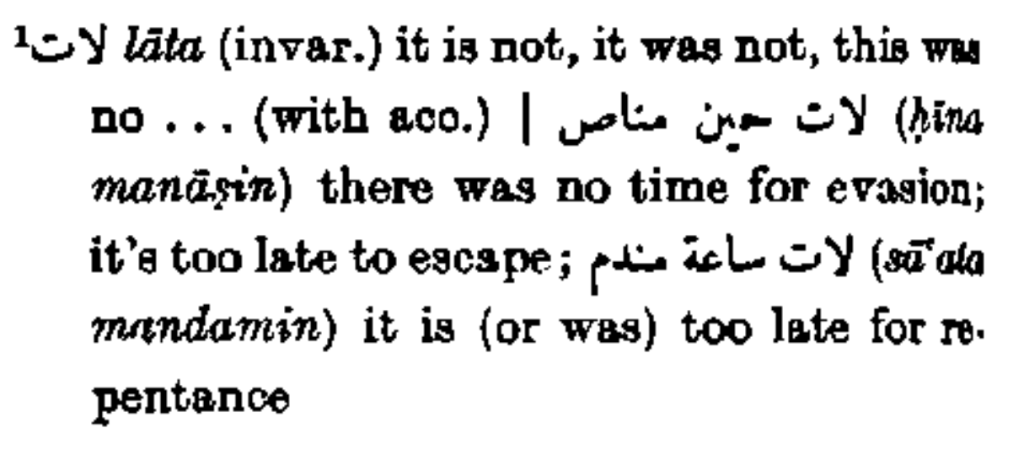
…لات occurs in examples where it’s followed by a noun of time, حين or ساعة. Drißner also mentions الأَون as another noun of time that can follow لات.
And, in this type of sentence (with لات and a noun of time), either the subject or predicate of لات must be omitted.
It’s usually the subject (اسم) that’s omitted, in which case the predicate (خبر) must be in the accusative case (منصوب).
Let’s take the example from the Hans Wehr:
لاتَ ساعةَ مَندَمٍ
it is/was too late for repentance
Here, we can’t see the subject (which we assume to be الساعةُ—i.e. لات الساعةُ ساعةَ مندم), so the object (an إضافة phrase starting with ساعة) is منصوب.
المعاني notes that you can have a noun other than a noun of time following لات, but in this case, لات would have no governing power—meaning that it would not make the predicate منصوب, and both the subject and predicate can be present.
That’s all for this week, but make sure to check out the latest Wehr Wednesdays post where we dealt with the phrase بعيد الشأو, and also stop by The Arabic Pages shop!
!إلى اللقاء
Follow The Arabic Pages on Instagram and Twitter, and find out how you can support this blog!
If you’d like to receive email notifications whenever a new post is published on The Arabic Pages, enter your email below and click “Subscribe”:
 The Arabic Pages