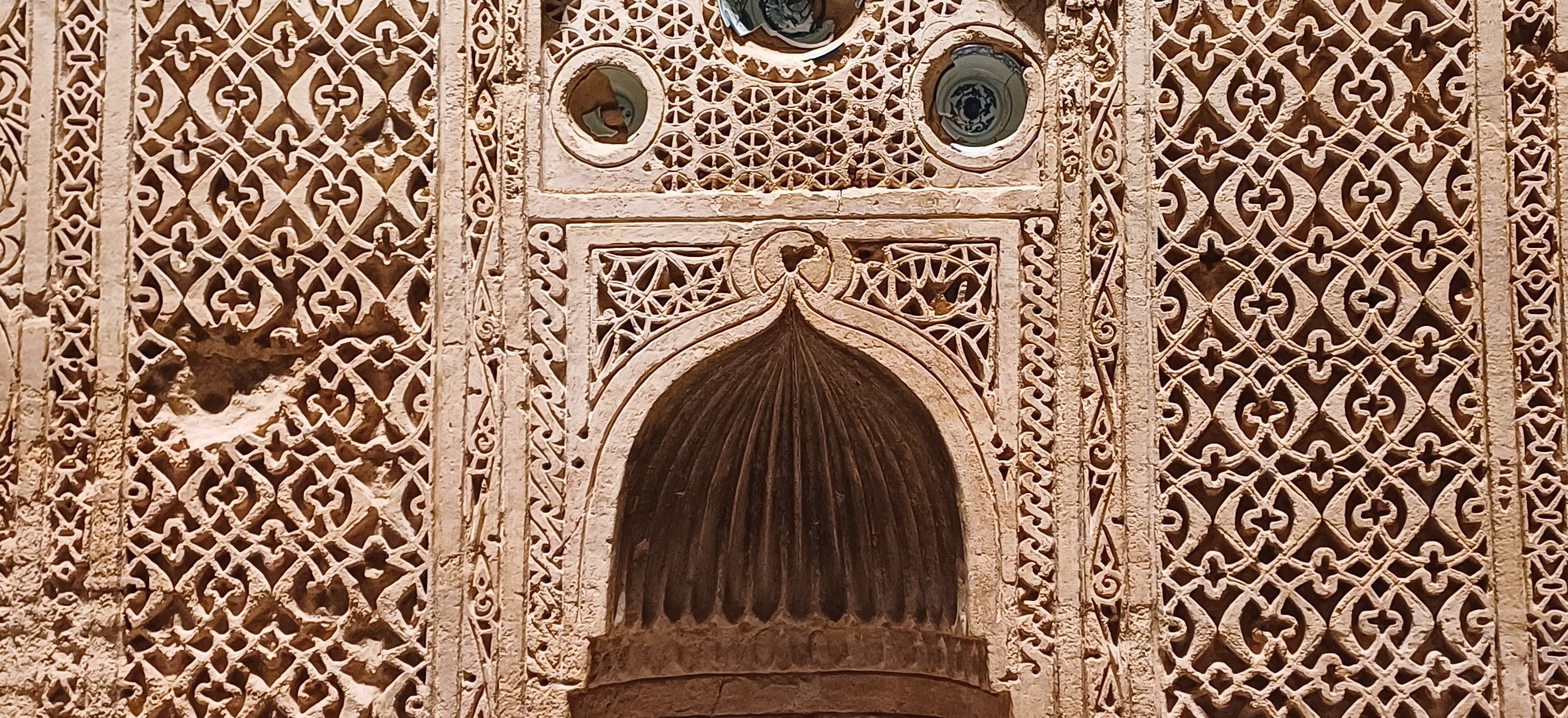
كَلام
root: ك-ل-م / noun / definition: speech
Since I stopped attending Akkadian evening classes, I’ve been feeling a little detached from this language I’d started falling in love with. And I miss learning and writing about the connections between Arabic and Akkadian—so here we are today.
I’ve previously explored some lexical similarities between the two languages, but this week I’m reflecting on Semitic roots that Arabic and Akkadian share. In particular: q-b-l, k-l-m, and m-l-k.
Let’s dive straight in:
q-b-l
This root in Arabic,ق-ب-ل, gives rise to many verbs. The form I قَبِلَ means to accept, the form III قابَلَ means to be face-to-face with, and the form X اِستَقبَلَ means to welcome someone—just to name a few.
At its core, the root ق-ب-ل is about facing something or someone.
As for the Akkadian…

…we see that the verb from the root q-b-l means to accept in Neo Babylonian (with the dictionary noting that it derived from Aramaic).
Interestingly, we see that in Old Babylonian, the same verb (possibly) means to fight. If so, that represents another alignment with the Arabic ق-ب-ل: the idea of two people or parties facing each other, a confrontation.
k-l-m
In Arabic, the root ك-ل-م is the core root for speech. From it, we get nouns like كَلِمة (a word) and verbs like the form II كَلَّمَ (to talk to someone).
In the Akkadian dictionary, we see an associated—but not identical—meaning:
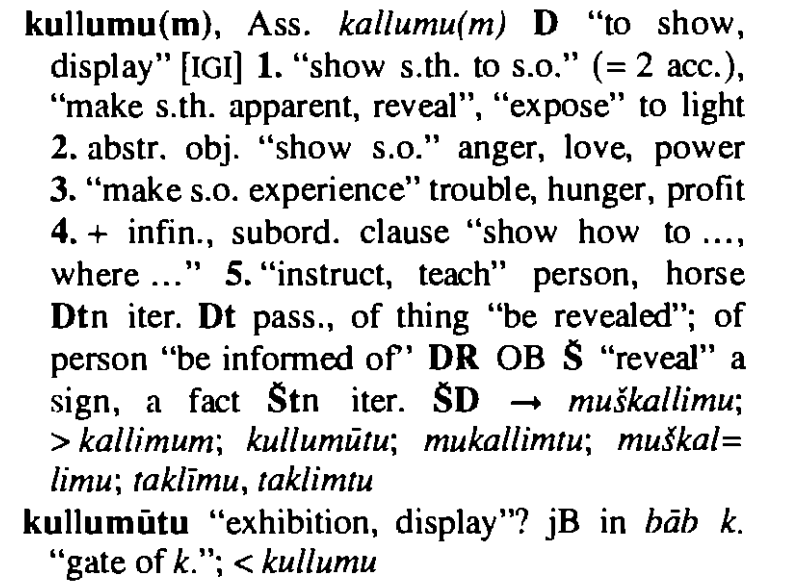
In Akkadian—and in both the Assyrian and Babylonian variants—the root k-l-m is all about showing and revealing.
And what is speech except the reveal of meaning and emotion?
m-l-k
The root م-ل-ك is all about possession and ownership. Other than its many derived verbs, it also gives us nouns like مُلك (dominion) and مَلِك (king).
In Akkadian, the same root carries a number of meanings:
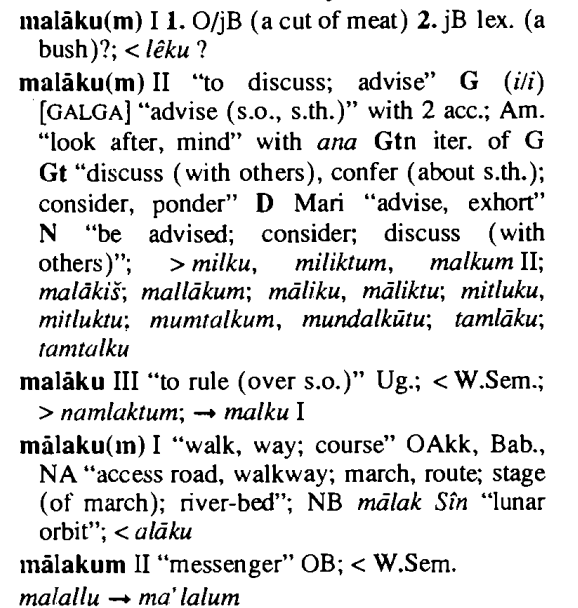
If we look at the third entry, malāku III, we find a meaning close to the Arabic: to rule over someone. (In the same way a king does.)
But—note what comes after the definition: Ug. (denoting an Ugaritic origin—a Northwestern Semitic language) and <W.Sem. (indicating that the word entered the language from a Western Semitic language).
And take a look at the final entry, mālakum II (where -um in the case ending) meaning “messenger“. Isn’t that similar to the Arabic مَلَك, meaning “angel“?
Well, things aren’t so simple with that one… I did a deep dive of this in Dictionary Finds: ء-ل-ك and Angels. Go ahead, it’s worth the read!
And that wraps things up for this post.
There are still so many Arabic-Akkadian posts I want to write. Especially on the similarities and differences between their verb forms.
If you fancy another post about Akkadian, how about these:
- Some Arabic-Akkadian Lexical Observations
- Arabic-Akkadian Observations: talmīd, تِلميذ, and a Lost Root
- and Arabic Epiphanies in Akkadian Class: خلق, the Rule of 12, and 19 Verb Forms?
!إلى اللقاء


If you’d like to receive email notifications whenever a new post is published on The Arabic Pages, enter your email below and click “Subscribe”:
 The Arabic Pages