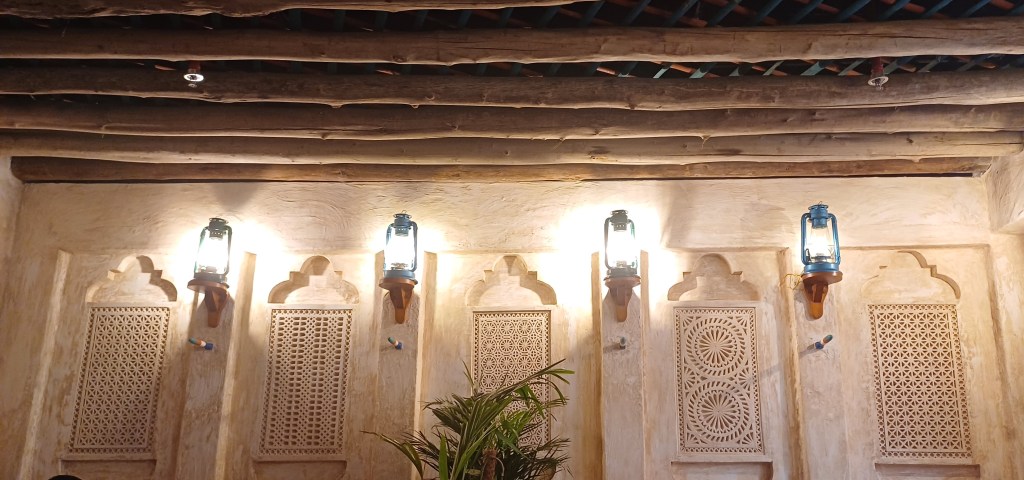
دار
root: د-و-ر / noun / plural: دِيار / definition: home
I had this idea a few days ago to vlog a week in my life as a PhD student. And now, every action poses a conundrum.
Like, do I record the aftermath of my disastrous attempt to bake a sugar-free brownie without a recipe or so much as a clue? Would my hypothetical audience find it interesting to watch me pour a rose-flavoured honey concoction over the resulting charcoal block to bring it to the edge of edibility?
And forget edibility— should I be worried about the credibility I’ll lose posting chaotic snippets of my days which, thus far, have scarcely featured “actual work”?
No, I shan’t. Worrying about that isn’t on my to-do list.
And, to be honest, this is what I love about PhD life: the flexibility, the freedom, the variety.
So, keep an eye out. Unless chaos stresses you out—in which case, look away.
One thing you will see in my vlog, though, is me perusing the dictionary. Which is how I stumbled upon the inspiration for this post.
You see, on page 1026 of the Hans Wehr dictionary, I came across this proverb:
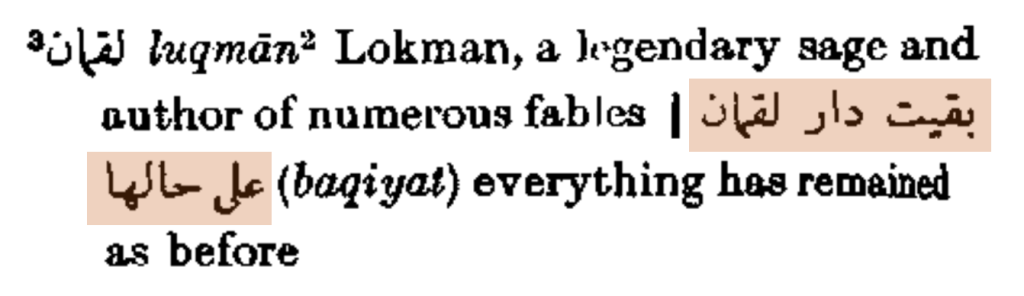
بَقِيَت دارُ لُقمانَ على حالِها, “everything has remained as before”.
(Note: the name لُقمان is a diptote, hence its final fatha in this phrase despite its genitive case—see Arabic Diptotes: الممنوع من الصرف for more!)
Hmm, I wondered. Is this a reference to the Luqman mentioned in the Qur’an?
Nope. It actually refers to someone called Ibrahim bin Luqman, who was the judge (القاضي) of the Egyptian city of Mansoura in the 13th century.
His house (originally built on the Nile riverbank) became well-known in Islamic history: it was where King Louis IX of France was held after being captured during his attempt to seize Egypt.
Saying that this house (دار لقمان) remained the same (بقيت على حالها) was a poetic warning to other would-be invaders—hinting that they too might meet the same fate as the French king.
So, its connotations—historically, for the Arab world—are positive. Although, apparently, many people nowadays use it to express frustration at the lack of change.
I wonder how the environments we’re raised in shape our attitudes towards change.
Some see its absence as stagnation and suffocation, whilst others see it as stability. Some see its presence as progress, whilst others perceive it as pandemonium.
It depends on the context, I guess.
I wrote a poem a few weeks back about my (metaphorical) inability to stop running. Maybe that’s why the clips I’ve recorded of my day-to-day life look as they do.
Change denotes moving into the unknown. But I’m simply too much of an optimist not to believe there’s something more beautiful waiting there.
!إلى اللقاء

Need advice with Arabic? Book a consultation with me.


If you’d like to receive email notifications whenever a new post is published on The Arabic Pages, enter your email below and click “Subscribe”:
 The Arabic Pages