مَلَك
root: م-ل-ك or ل-ء-ك or ء-ل-ك… / noun / plural: مَلائِكة / definition: angel
I had a conversation with my teacher about the Akkadian root ʔ-l-k (the equivalent of ء-ل-ك) which carries the general meaning of “to go” and, discussing one of his theories, he mentioned that he wasn’t sure whether this ancient Semitic root survived to Modern Arabic.
And, sure, there was no trace of the root in the Hans Wehr—but I did find it in Lane’s Lexicon, where I was met with a really surprising entry.
I’m going to share this intriguing find with you in reverse order to how I pieced it together, so it’ll make more sense…
And for that, we need to start by looking up the word for “angel” in Arabic, مَلَك.
Hans Wehr is my go-to for vocabulary searches, and we might assume مَلَك comes from the root م-ل-ك. And indeed we can find it under that root on page 1082:

…but note how the dictionary indicates that the original form of the word is مَلأَك. Which would be from the root ل-ء-ك.
Sure enough, when we flick to page 1000 of the Wehr, we find مَلأك under the root:

Note how the form IV verb from the root, أَلأَكَ / يُلئِكُ, means “to send as a messenger”. Form IV verbs have a causative meaning. So we can infer that the general meaning of the root is “to send a message”.
The noun مَلأَك follows the مَفعَل pattern, which is one of the patterns used to indicate instruments or tools. Meaning that ملأك, or “angel”, literally means “the one used for sending a message”.
That’s neat. And it seems like the end of our search, right?
No!
While the Hans Wehr doesn’t give us another lead to follow, Lane’s Lexicon does.
On page 3007 of the Lane’s Lexicon Supplement, we go to the root ل-ء-ك…

…which tells us to take a look at the root ء-ل-ك.
So, we’re on page 81 of Lane’s Lexicon now (where I started my actual discovery), and we’re looking at the root ء-ل-ك. Under the entry for the form I verb, we find this:

…which tells us the form I verb أَلَكَ / يَألِكُ means “to send” or “to communicate a message”.
And then we head down to the form IV verb, and this is where things get really interesting.
The entry mentions that the hamza shifted from first to second root position in this verb:
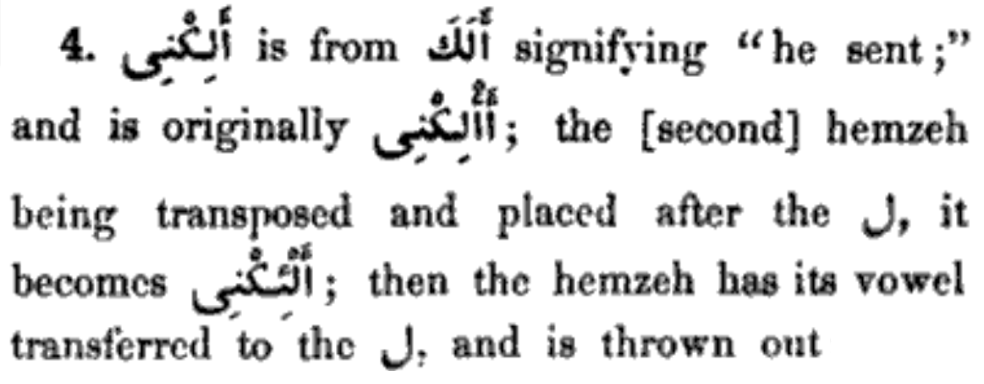
…and this is what gave us the root ل-ء-ك that we found in both dictionaries. But Lane’s Lexicon goes on:

…where it clarifies that مَألَك (root ء-ل-ك) was the original word for “angel”; it then became مَلأَك (root ل-ء-ك) with the shift of the hamza in the root; and then eventually the hamza disappeared altogether and we get the word مَلَك!
You can find even more derivation information on the next page of Lane’s Lexicon, under the entry مألك itself.
What a linguistic gem. And I wonder if the Arabic root ء-ل-ك is related to the Akkadian ʔ-l-k after all?
Read about my other dictionary finds here, and take a look at Seats of the Hamza (ء) if you’re curious about the orthographic conventions of the hamza.
See you on my next post!
!إلى اللقاء
Follow The Arabic Pages on Instagram and Twitter, and find out how you can support this blog!
If you’d like to receive email notifications whenever a new post is published on The Arabic Pages, enter your email below and click “Subscribe”:
 The Arabic Pages
One thought on “Dictionary Finds: ء-ل-ك and Angels”