التَّمْر
root: ت-م-ر / collective noun / definition: dates
Akkadian class flew by this week as we ate dates and drank (only mê, water, not karān-am, wine) all in order to learn new vocabulary and begin talking about our daily routines.
I noted how the Akkadian word for “star”, kakkab-um, mirrors the Arabic كَوكَبٌ, kawkab-un, and I still haven’t worked out why it makes me so happy to see similarities between these two languages that I know are related.
I also don’t know why I keep noticing the absence of the ring on my hand—I lost it at the airport and my ring finger has been feeling strangely bare since then, even though I never wore it daily. Its only value was sentimental but I guess that’s why its loss is all the more noticeable.
But let me snap my thoughts back to this post, seeing as I already filled out a lost item form a week ago and have given up hope in recovering the said ring. (I wonder if Akkadian has a word for evanescence…)
I keep digressing. It’s just one of those days and I have a headache.
For this post, we’re heading back to the novel we looked at last time in the reading literature series, Ahmed Saadawi’s فرانكشتاين في بغداد. Here are some interesting words and phrases I wanted to share:
الليلة الليلاء

Both components of this noun-adjective phrase, as you may have guessed, are derived from the same root, ل-ي-ل.
لَيْلة لَيْلاء means “a dark night”. In my head, it’s a bit like saying a night-y night. So night-y.
The Hans Wehr also mentions that في ليلة ليلاء means “under the cover of night” which reminds me of the phrase we saw in Wehr Wednesdays #235.
يتطاير منها الشرر

So I actually included this one because I thought we’d talked about this phrase before on the blog. Apparently not. Well, not that I can find.
Anyway, تَطايَرَ / يَتَطايَرُ is a form VI verb from the root ط-ي-ر. It means “to fly in all directions”. Its subject here is the collective noun الشَّرَر (“sparks”).
So, looking at its context, بِنَظَراتِهِ الَّتي يَتَطايَرُ مِنها الشَّرَر means “with his looks from which sparks were flying in all directions”. Basically, he was giving some angry glares.
انحدار الشمس إلى المغيب

I liked this phrase because it can be read in more than one way.
اِنحِدار is a form VII verbal noun from the verb اِنحَدَرَ / يَنحَدِرُ (root: ح-د-ر). The verb can denote a few things, but the most relevant ones here are:
- to descend
- to arrive
And مَغيب is a place noun (see: The مَـ of Place and Time) from the root غ-ي-ب meaning “(the place or time of) the setting of the Sun”.
So you could read اِنحِدار الشَّمسِ إلى المَغيب as either: “the arrival of the Sun at its place of setting” or “the descent of the Sun to its place of setting”.
You might ask: what difference does it make?
I can’t deal with existential questions right now (it’s the headache), but I think meanings matter. (That’s actually a good summary of my PhD, come to think of it…)
(Side note: a cool meaning of انحدر mentioned in the dictionary is “to extend back to former times and be transmitted from them”. I wonder in which context that would be used.)
من دون لف ودوران

A nice phrase.
I’d translate مِن دونِ لَفّ وَدَوَران to something like “without beating around the bush”. It literally translates as “without wrapping and going around”.
On its own, من غير لفّ (where من غير carries the same meaning as من دون) translates as “without much ado”.
خميرة لـ

Okay, this one has a fun metaphorical derivation.
خَميرة literally means “yeast”. Which is something, as we know, that helps bread to rise and causes the fermentation needed to produce alcohol.
Now figuratively, خميرة means “a basis from which something greater develops”. Nice.
In this context (i.e. خميرة لقصة), it’s alluding to material or inspiration from which a story can be invented.
لمس أنه
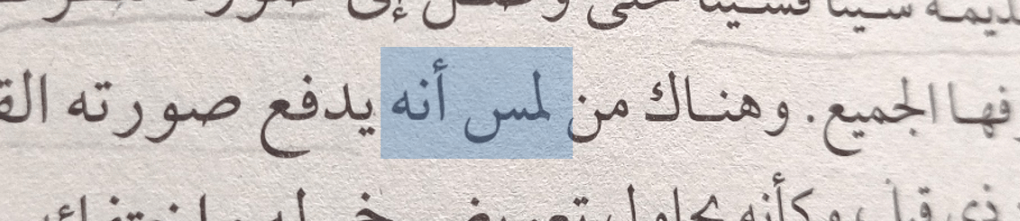
We often go for the form III verb لاحَظَ / يُلاحِظُ when we want to express “to notice” in Arabic.
But we can also use this form I verb: لَمَسَ / يَلمِسُ. With أَنَّ, it means “to notice that”.
على حدة

I really should have highlighted the previous word, كُلّاً, here. But it’s too late because I closed the document I edited these pictures on without saving it, so we’ll all have to bear the inconvenience.
كُلّ على حِدَةٍ means “each (person) separately / by themselves”. حدة comes from the root و-ح-د, related to the number one, individuality, and unity.
المتعرقن

And for the final word, I need to hand over to you!
I couldn’t find the meaning of this word… has anyone heard of متعرقن? Let me know!
I hope my digressions in this post haven’t given you a headache. See you on the next one.
!مع السلامة


If you’d like to receive email notifications whenever a new post is published on The Arabic Pages, enter your email below and click “Subscribe”:
 The Arabic Pages
المتعرقن
Sweating/ sweaty ? But I’d have to see the context in the sentence fully.
I thought it might have something to do with عرق at first, but the ن at the end threw me off 🤔
Here’s the context:
[…] ثم ذلك الرجل الجزائري *المتعرقن* الذي يستمتع بحياة متقشفة شبه صامتة على مدار اليوم، ويعتاش فعليا على مطبخ الخيرات […]
I assume the adjective is describing his lifestyle that is elaborated on slightly here… Thoughts?